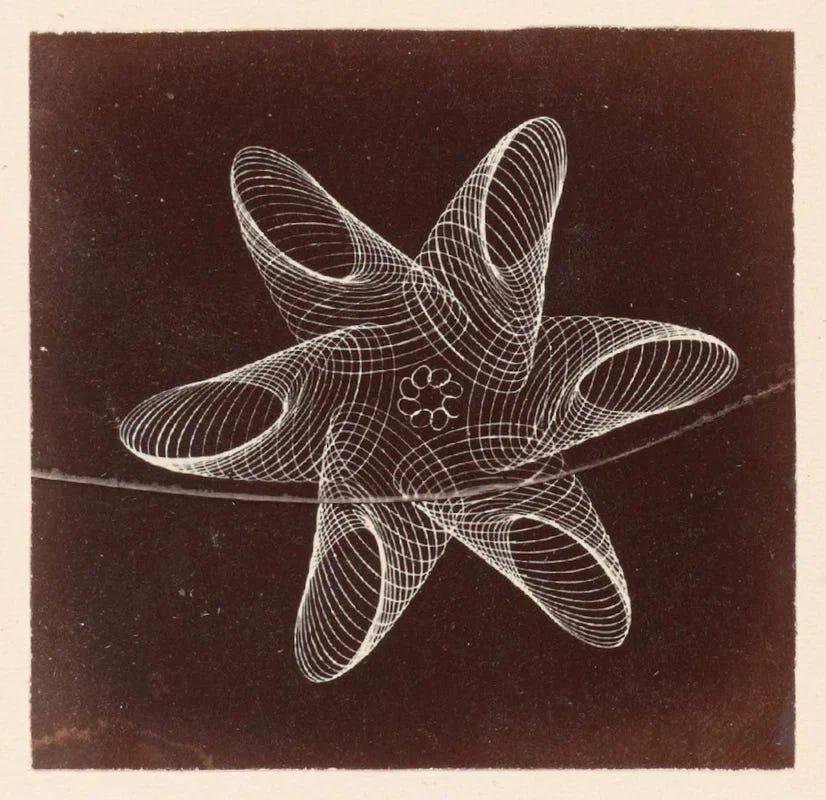
Move Yourself First
Movement is not something you can hand to another person. You can only transmit a motion you already carry.
We talk about leaders who “move” people, about ideas that are “moving,” about being “moved” by a piece of work — and we treat it as a metaphor. It isn’t, quite. Look at the words we reach for — emotion, motivation. Both are built around the same buried verb: to move. Nothing moves out of you that wasn’t already moving in you. This is why you can feel a connection to an idea or a person in a subjective and often inexplicable way.
You can tell when the person speaking is in motion, and when they are standing perfectly still inside, hoping the room will move on their behalf. It almost never does.
In the Phaedrus, Plato defines the soul as the thing that moves itself — the one mover whose motion is not borrowed from somewhere else. Everything else in the world gets pushed; it receives its motion secondhand, passed along like a shove down a line of dominoes. The soul is different. It is a source. And because it is a source, Plato says, it is the origin from which all other motion flows.
If you are not in motion yourself, you have nothing to transmit. You can apply pressure — and pressure is what most people fall back on when they have no inner movement to share. You can push, cajole, incentivize, or repeat yourself louder. But pressure only ever relocates a force; it cannot originate one. The people in the room can feel the difference between being pushed and being moved, even when they couldn’t name it.
The original motion has only one source. The capacity to set yourself in motion — to begin from the inside, with nothing pushing you — is what we should actually mean by imagination — not daydreaming or fantasy, not the decorative thing we relegate to children and artists, but the power to start. It is self-inspiration in the literal sense of the word: in-spirare, to breathe in. Before inspiration is something you do to a room, it is something you do to yourself.
Two later thinkers carry the idea forward. Henri Bergson, writing about life itself, refused to see living things as machinery being pushed around by outside forces. He called what drives them the élan vital — a current that is creative and unrepeatable, that generates motion rather than merely passing it on. To be alive, for Bergson, is to make movement, not to receive it. And Hannah Arendt, much later and far more concerned with people than with biology, gave this human capacity a name: natality. We are, she said, beings who can begin — who can introduce something genuinely new into the world, an act that is not a reaction to what came before but a fresh start.
The leader or teacher who genuinely moves others is the one who has first, quietly, moved themselves. Imagination is the practiced capacity to generate that inner motion and begin. And everything that reaches other people afterward is only conduction — the heat traveling outward from a source that was already warm.
That word — practiced — is the part we get wrong. We treat inspiration as a mood that arrives, or doesn’t — a weather system. But if imagination is the faculty of moving yourself, then it is trainable, the way any capacity is trainable. It is a discipline before it is a feeling.
This is most of what I actually do as a coach and a teacher. I almost never tell people what to think. I ask them to find the motion already latent in their own thinking — to locate the place where something in them is genuinely moving, and to articulate its value, so that it can move someone else. Because nothing I install in you from the outside will hold. Only the motion you generate yourself will carry.
So, before you try to move the room, check whether you are moving.
Inspire yourself, and the rest will follow.

